Datei:Potw1327a.tif


Originaldatei (734 × 734 Pixel, Dateigröße: 896 KB, MIME-Typ: image/tiff)
Beschreibung
| Beschreibung |
English: Stars that go out with a whimper
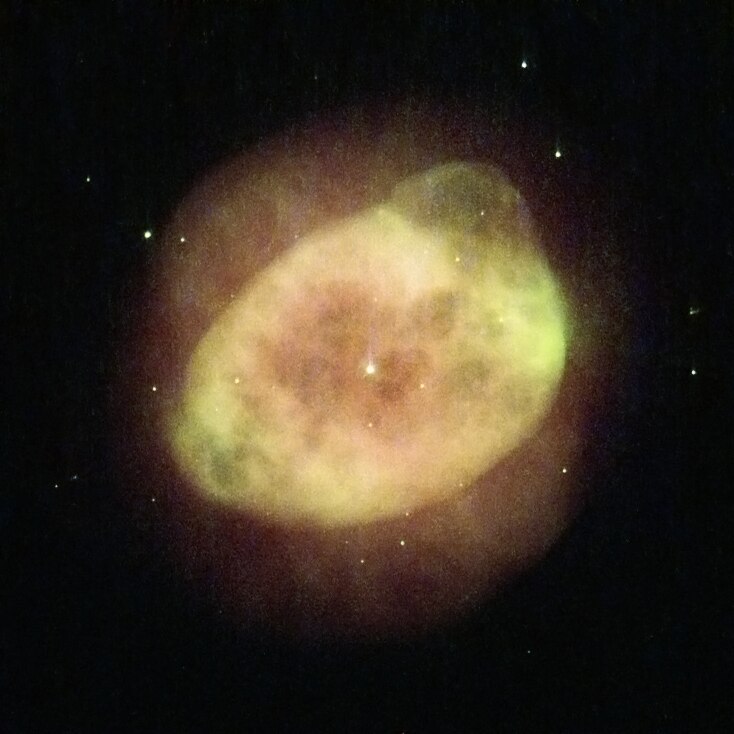
This NASA/ESA Hubble Space Telescope image shows the planetary nebula IC 289, located in the northern constellation of Cassiopeia. Formerly a star like our Sun, it is now just a cloud of ionised gas being pushed out into space by the remnants of the star’s core, visible as a small bright dot in the middle of the cloud. Weirdly enough, planetary nebulae have nothing to do with planets. Early observers, when looking through small telescopes, could only see undefined, smoky forms that looked like gaseous planets — hence the name. The term has stuck even though modern telescopes like Hubble have made it clear that these objects are not planets at all, but the outer layers of dying stars being thrown off into space. Stars shine as a result of nuclear fusion reactions in their cores, converting hydrogen to helium. All stars are stable, balancing the inward push caused by their gravity with the outwards thrust from the inner fusion reactions in their cores. When all the hydrogen is consumed the equilibrium is broken; the gravitational forces become more powerful than the outward pressure from the fusion process and the core starts to collapse, heating up as it does so. When the hot, shrinking core gets hot enough, the helium nuclei begin to fuse into carbon and oxygen and the collapse stops. However, this helium-burning phase is highly unstable and huge pulsations build up, eventually becoming large enough to blow the whole star’s atmosphere away. A version of this image was entered into the Hubble’s Hidden Treasures image processing competition by contestant Serge Meunier. Credit: ESA/Hubble & NASA Acknowledgement: Serge Meunier Credit: ESA/Hubble & NASA Acknowledgement: Judy Schmidt About the Object Name: IC 289 Type: • Milky Way : Nebula : Type : Planetary • Nebulae Images/Videos Colours & filters Band Wavelength Telescope Optical B 469 nm Hubble Space Telescope WFPC2 Optical V 502 nm Hubble Space Telescope WFPC2 Optical H-alpha 656 nm Hubble Space Telescope WFPC2 Optical R 658 nm Hubble Space Telescope WFPC2. |
| Datum | Release date: 8 July 2013, 10:00 |
| Quelle | http://www.spacetelescope.org/images/potw1326a/ http://www.spacetelescope.org/static/archives/images/original/potw1326a.tif |
| Urheber | ESA/Hubble & NASA Acknowledgement: Serge Meunier |
| Genehmigung (Weiternutzung dieser Datei) |
http://www.spacetelescope.org/copyright/ |
Lizenz


- Dieses Werk darf von dir
- verbreitet werden – vervielfältigt, verbreitet und öffentlich zugänglich gemacht werden
- neu zusammengestellt werden – abgewandelt und bearbeitet werden
- Zu den folgenden Bedingungen:
- Namensnennung – Du musst angemessene Urheber- und Rechteangaben machen, einen Link zur Lizenz beifügen und angeben, ob Änderungen vorgenommen wurden. Diese Angaben dürfen in jeder angemessenen Art und Weise gemacht werden, allerdings nicht so, dass der Eindruck entsteht, der Lizenzgeber unterstütze gerade dich oder deine Nutzung besonders.
Dateiversionen
Klicke auf einen Zeitpunkt, um diese Version zu laden.
| Version vom | Vorschaubild | Maße | Benutzer | Kommentar | |
|---|---|---|---|---|---|
| aktuell | 23:27, 10. Jul. 2013 |  | 734 × 734 (896 KB) | wikimediacommons>Fabian RRRR | == {{int:filedesc}} == {{Information |Description ={{en|1='''Stars that go out with a whimper This NASA/ESA Hubble Space Telescope image shows the planetary nebula IC 289, located in the northern constellation of Cassiopeia. Formerly a star like ou... |
Dateiverwendung
Die folgende Seite verwendet diese Datei: