Datei:NGC 4861 - HST- Potw1704a.tif



Originaldatei (3.885 × 3.107 Pixel, Dateigröße: 69,11 MB, MIME-Typ: image/tiff)
Beschreibung
| Beschreibung |
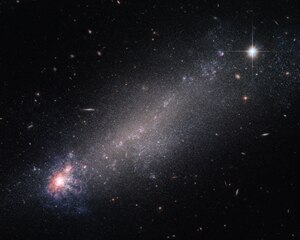
English: The lesser-known constellation of Canes Venatici (The Hunting Dogs), is home to a variety of deep-sky objects — including this beautiful galaxy, known as NGC 4861. Astronomers are still debating on how to classify it: While its physical properties — such as mass, size and rotational velocity — indicate it to be a spiral galaxy, its appearance looks more like a comet with its dense, luminous “head” and dimmer “tail” trailing behind. Features more fitting with a dwarf irregular galaxy.
Although small and messy, galaxies like NGC 4861 provide astronomers with interesting opportunities for study. Small galaxies have lower gravitational potentials, which simply means that it takes less energy to move stuff about inside them than it does in other galaxies. As a result, moving in, around, and through such a tiny galaxy is quite easy to do, making them far more likely to be suffused with streams and outflows of speedy charged particles known as galactic winds, which can flood such galaxies with little effort. These galactic winds can be powered by the ongoing process of star formation, which involves huge amounts of energy. New stars are springing into life within the bright, colourful ‘head’ of NGC 4861 and ejecting streams of high-speed particles as they do so, which flood outwards to join the wider galactic wind. While NGC 4861 would be a perfect candidate to study such winds, recent studies did not find any galactic winds in it. Credit: ESA/Hubble & NASA Coordinates Position (RA): 12 59 2.76 Position (Dec): 34° 51' 46.80" Field of view: 3.24 x 2.59 arcminutes Orientation: North is 80.3° right of vertical Colours & filters Band Wavelength Telescope Optical V 606 nm Hubble Space Telescope ACS Optical V 606 nm Hubble Space Telescope ACS Optical I 814 nm Hubble Space Telescope ACS Optical NII 658 nm Hubble Space Telescope WFC3 Optical SII 673 nm Hubble Space Telescope WFC3 Optical I 814 nm Hubble Space Telescope ACS. |
| Datum | |
| Quelle | http://spacetelescope.org/images/potw1704a/ http://spacetelescope.org/static/archives/images/original/potw1704a.tif |
| Urheber | Credit: ESA/Hubble & NASA |
Lizenz
  |
ESA/Hubble images, videos and web texts are released by the ESA under the Creative Commons Attribution 4.0 International license and may on a non-exclusive basis be reproduced without fee provided they are clearly and visibly credited. Detailed conditions are below; see the ESA copyright statement for full information. For images created by NASA or on the hubblesite.org website, or for ESA/Hubble images on the esahubble.org site before 2009, use the {{PD-Hubble}} tag.
Conditions:
Notes:
|
.jpg) |
- Dieses Werk darf von dir
- verbreitet werden – vervielfältigt, verbreitet und öffentlich zugänglich gemacht werden
- neu zusammengestellt werden – abgewandelt und bearbeitet werden
- Zu den folgenden Bedingungen:
- Namensnennung – Du musst angemessene Urheber- und Rechteangaben machen, einen Link zur Lizenz beifügen und angeben, ob Änderungen vorgenommen wurden. Diese Angaben dürfen in jeder angemessenen Art und Weise gemacht werden, allerdings nicht so, dass der Eindruck entsteht, der Lizenzgeber unterstütze gerade dich oder deine Nutzung besonders.
Dateiversionen
Klicke auf einen Zeitpunkt, um diese Version zu laden.
| Version vom | Vorschaubild | Maße | Benutzer | Kommentar | |
|---|---|---|---|---|---|
| aktuell | 11:36, 23. Jan. 2017 |  | 3.885 × 3.107 (69,11 MB) | wikimediacommons>Fabian RRRR | =={{int:filedesc}}== {{Information |description={{en|1=The lesser-known constellation of Canes Venatici (The Hunting Dogs), is home to a variety of deep-sky objects — including this beautiful galaxy, known as NGC 4861. Astronomers are still debating... |
Dateiverwendung
Die folgende Seite verwendet diese Datei: