
Datei:Protostellar jet.jpg


Originaldatei (2.401 × 3.001 Pixel, Dateigröße: 430 KB, MIME-Typ: image/jpeg)
Beschreibung
| Beschreibung |
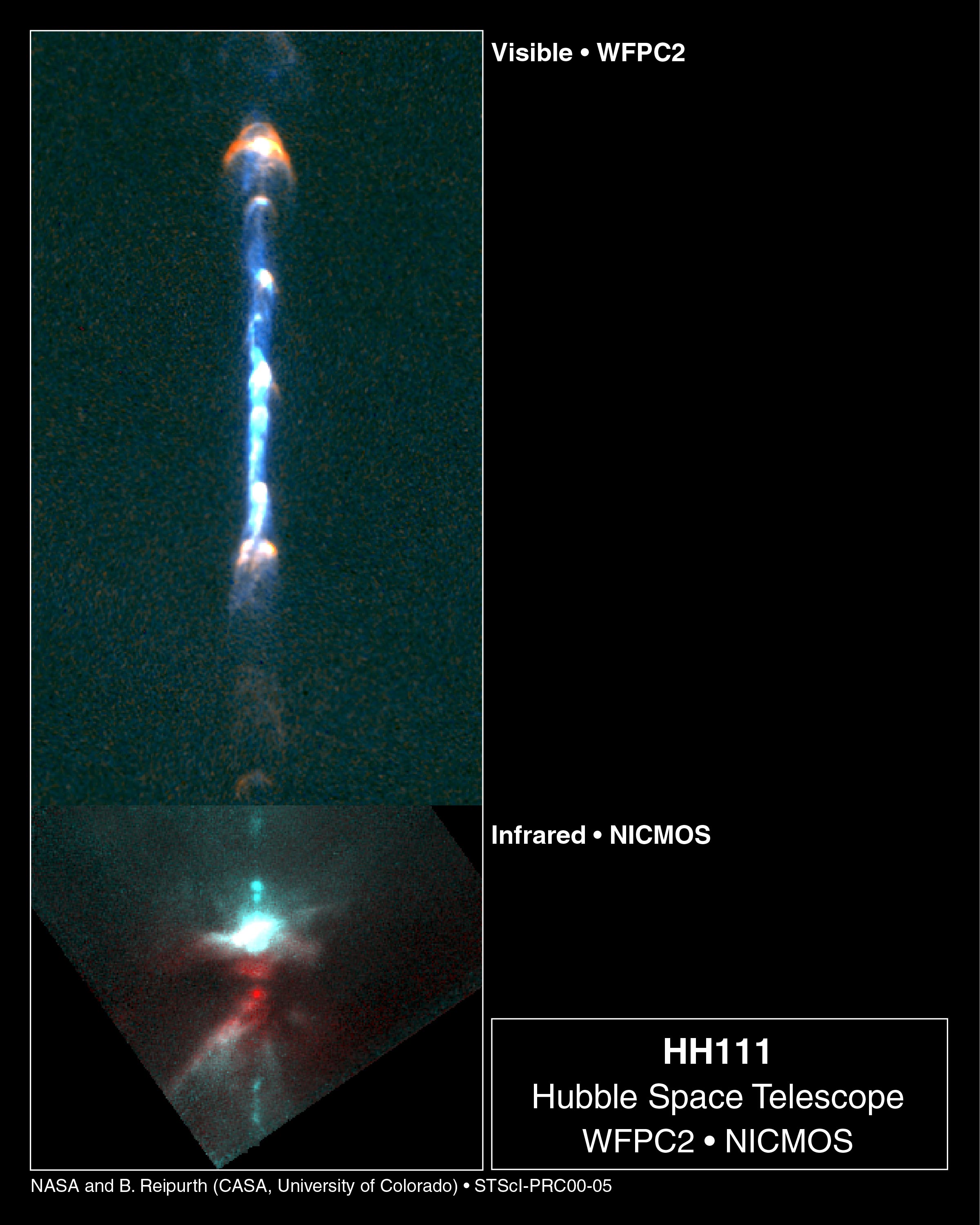
English: This composite image, made with two cameras aboard NASA's Hubble Space Telescope, shows a pair of 12 light-year-long jets of gas blasted into space from a young system of three stars. The jet is seen in visible light, and its dusty disk and stars are seen in infrared light. These stars are located near a huge torus, or donut, of gas and dust from which they formed. This torus is tilted edge-on and can be seen as a dark bar near the bottom of the picture.
Apparently, a gravitational brawl among the stars occurred a few thousand years ago and kicked out one member (on the left edge of the bright blob above the disk). As a result, the two other stars were joined together as a tight binary pair and flew off in the opposite direction, and appear as a red blob below the disk. The huge jet comes from one of the stars in this tight binary pair. The star spews out streams of gas in opposite directions, like water from a garden hose. It is not a smooth flow, but rather happens episodically, creating lumps of gas that fly across space at over one million miles per hour. These gaseous cannonballs catch up with and "rear-end" slower moving blobs, creating a pattern that resembles a string of Christmas lights embedded in the jet. The visible-light image was taken with Hubble's Wide Field Planetary Camera 2 in Nov. 1998 and the infrared image by Hubble's Near Infrared Camera and Multi-Object Spectrometer in Mar. 1998. The disk and associated stars are embedded in a large dark cloud and are only visible at infrared wavelengths.Deutsch: Protostellarer Jet. Visuell aufgenommenes Bild (oben): Der Jet schießt nach oben. Infrarotbild (unten): Der dunkle horizontale Balken ist die absorbierende Scheibe, die den Protostern umgibt. |
| Datum | (released) |
| Quelle | http://hubblesite.org/image/937/news_release/2000-05 |
| Urheber | NASA and B. Reipurth (CASA, Univ. of Colorado) |
| Genehmigung (Weiternutzung dieser Datei) |
http://hubblesite.org/copyright/ |
| Andere Versionen | File:HH111 HST infrared visible.jpg |

Lizenz

|
Diese Datei ist gemeinfrei, da sie von NASA und ESA erstellt wurde. Das Hubble-Material der NASA (und das Hubble-Material der ESA vor 2009) ist urheberrechtsfrei und kann ohne Gebühr als gemeinfrei verwendet werden, sofern nur die NASA, das STScI und/oder die ESA als Quelle des Materials angegeben werden. Diese Lizenz gilt nicht, wenn ESA-Material, das nach 2008 erstellt wurde, oder Quellmaterial anderer Organisationen verwendet wird.
Das Material wurde für die NASA vom Space Telescope Science Institute unter dem Vertrag NAS5-26555 oder für die ESA vom Hubble European Space Agency Information Centre erstellt. Urheberrechtserklärung auf hubblesite.org oder 2008 Urheberrechtserklärung auf spacetelescope.org. Für Material, das von der European Space Agency auf der Website spacetelescope.org seit 2009 erstellt wurde, verwende die Lizenzvorlage {{ESA-Hubble}}. |
Ursprüngliches Datei-Logbuch
Übertragen aus de.wikipedia nach Commons durch Nachcommonsverschieber mithilfe des CommonsHelper.

- 2004-04-05 11:09 Rivi 575×750× (51863 bytes) Protestellarer Jet, NASA/HST Bild
Dateiversionen
Klicke auf einen Zeitpunkt, um diese Version zu laden.
| Version vom | Vorschaubild | Maße | Benutzer | Kommentar | |
|---|---|---|---|---|---|
| aktuell | 14:36, 26. Apr. 2019 | | 2.401 × 3.001 (430 KB) | wikimediacommons>Huntster | Full resolution from source. |
Dateiverwendung
Die folgenden 3 Seiten verwenden diese Datei:
