Datei:Prograde and retrograde circular orbital velocity.gif

Prograde_and_retrograde_circular_orbital_velocity.gif (513 × 322 Pixel, Dateigröße: 2,27 MB, MIME-Typ: image/gif, Endlosschleife, 1.000 Bilder, 42 s)
Hinweis: Aufgrund technischer Beschränkungen werden Vorschaubilder hochauflösender GIF-Dateien wie dieser nicht animiert.
Beschreibung
| Beschreibung |
Deutsch: Prograde und retrograde äquatoriale Kreisbahngeschwindigkeit um ein rotierendes schwarzes Loch. a ist der Spinparameter in Einheiten von J·c/G/M² mit J als dem Drehimpuls des schwarzen Lochs. Die x-Achse ist der Boyer-Lindquist-Radius r, und die y-Achse die lokale 3er-Geschwindigkeit v. Die linke vertikale Hilfslinie bezeichnet den Ereignishorizont (rH) bei r=(1+√(1-a²))GM/c², und die beiden an die Funktionskurven anschließenden vertikalen Hilfslinien die Radien für den pro- (r+) und retrograden (r-) Photonenkreis auf r±=2(1+cos(2arccos(±a))/3)GM/c². Weiterführende Erklärung: Herleitung / Details
English: Prograde and retrograde equatorial circular orbit velocity around a rotating black hole. a is the spin parameter in units of J·c/G/M² where J ist the angular momentum of the black hole. The x-axis is the Boyer-Lindquist-Radius r, and the y-axis the local 3-velocity v. The left vertical gridline depicts the event horizon (rH) at r=(1+√(1-a²))GM/c², and the two vertical gridlines connecting to the function curves are the pro- (r+) and retrograde (r-) photon-orbits at r±=2(1+cos(2arccos(±a))/3)GM/c². Further reading: derivation / details |
| Datum | |
| Quelle | Eigenes Werk |
| Urheber | Yukterez (Simon Tyran, Vienna) |
| Andere Versionen |
 |
en: Equations
The pro- and retrograde circular orbital velocity is derived by setting

and solving for . This gives the solution

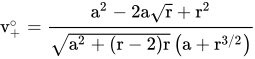
for the prograde and
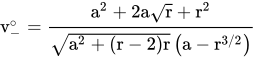
for the retrograde velocity.[1] For photons with one gets


for the prograde photon orbit radius (in Boyer-Lindquist-coordinates), and

for the retrograde one.[2] In the Schwarzschild-limit with both radii converge to .


Natural units:


de: Formeln
Die pro- und retrograde Kreisbahngeschwindigkeit ergibt sich indem
gesetzt und nach aufgelöst wird. Damit ergibt sich als Lösung
für die prograde und
für die retrograde Kreisbahngeschwindigkeit.[1] Für Photonen mit ergibt sich daher
für den prograden Photonenkreisradius (in Boyer-Lindquist-Koordinaten), und
für den retrograden.[2] Im Schwarzschild-Limit mit fallen beide Radien auf .
Natürliche Einheiten:
Code
(* Syntax: Mathematica *)
ClearAll["Global`*"]
vretro[a_,r_]:=(a^2+2 a Sqrt[r]+r^2)/(Sqrt[a^2+(-2+r) r] (a-r^(3/2)));
vprogr[a_,r_]:=(a^2-2 a Sqrt[r]+r^2)/(Sqrt[a^2+(-2+r) r] (a+r^(3/2)));
rh = 1 + Sqrt[1 - a^2];
r1 = 2 (1 + Cos[2/3 ArcCos[-a]]);
r2 = 2 (1 + Cos[2/3 ArcCos[+a]]);
Do[Print[Rasterize[Grid[{{Show[
Plot[{vprogr[a, r], vretro[a, r]}, {r, 1, 10},
PlotRange->{{1, 10}, {-1, 1}},
GridLines->{{rh, r1, r2}, {}},
Frame->True, ImageSize->500,
PlotStyle -> {{Blue, Thick}, {Magenta, Thick}}],
Graphics[{LightGray, Rectangle[{1, -1}, {rh, 1}]}]]},
{"a"->a}, {"rH"->rh}, {"r+"->r1}, {"r-"->r2}},
Alignment -> Left]]],
{a, 0.0, 1.0, 0.1}]
(* kerr.yukterez.net *)
Lizenz


- Dieses Werk darf von dir
- verbreitet werden – vervielfältigt, verbreitet und öffentlich zugänglich gemacht werden
- neu zusammengestellt werden – abgewandelt und bearbeitet werden
- Zu den folgenden Bedingungen:
- Namensnennung – Du musst angemessene Urheber- und Rechteangaben machen, einen Link zur Lizenz beifügen und angeben, ob Änderungen vorgenommen wurden. Diese Angaben dürfen in jeder angemessenen Art und Weise gemacht werden, allerdings nicht so, dass der Eindruck entsteht, der Lizenzgeber unterstütze gerade dich oder deine Nutzung besonders.
- Weitergabe unter gleichen Bedingungen – Wenn du das Material wiedermischst, transformierst oder darauf aufbaust, musst du deine Beiträge unter der gleichen oder einer kompatiblen Lizenz wie das Original verbreiten.
References
- ↑ a b Simon Tyran: Kreisbahnen in der Kerr-Raumzeit
- ↑ a b Edward Teo: Spherical Photon Orbits Around A Kerr Black Hole
File usage in Wikipedia articles
de.wikipedia.org/wiki/Kerr-Metrik
Dateiversionen
Klicke auf einen Zeitpunkt, um diese Version zu laden.
| Version vom | Vorschaubild | Maße | Benutzer | Kommentar | |
|---|---|---|---|---|---|
| aktuell | 00:59, 20. Jul. 2017 | | 513 × 322 (2,27 MB) | wikimediacommons>Yukterez | insert pause at a=0 and a=1, add r coordinate of the event horizon and the photon orbit radii |
Dateiverwendung
Keine Seiten verwenden diese Datei.
