Datei:PIA19059-SaturnMoon-Enceladus-OceanMethane-20150311.png

Originaldatei (4.820 × 3.906 Pixel, Dateigröße: 7,6 MB, MIME-Typ: image/png)
Beschreibung
| Beschreibung |
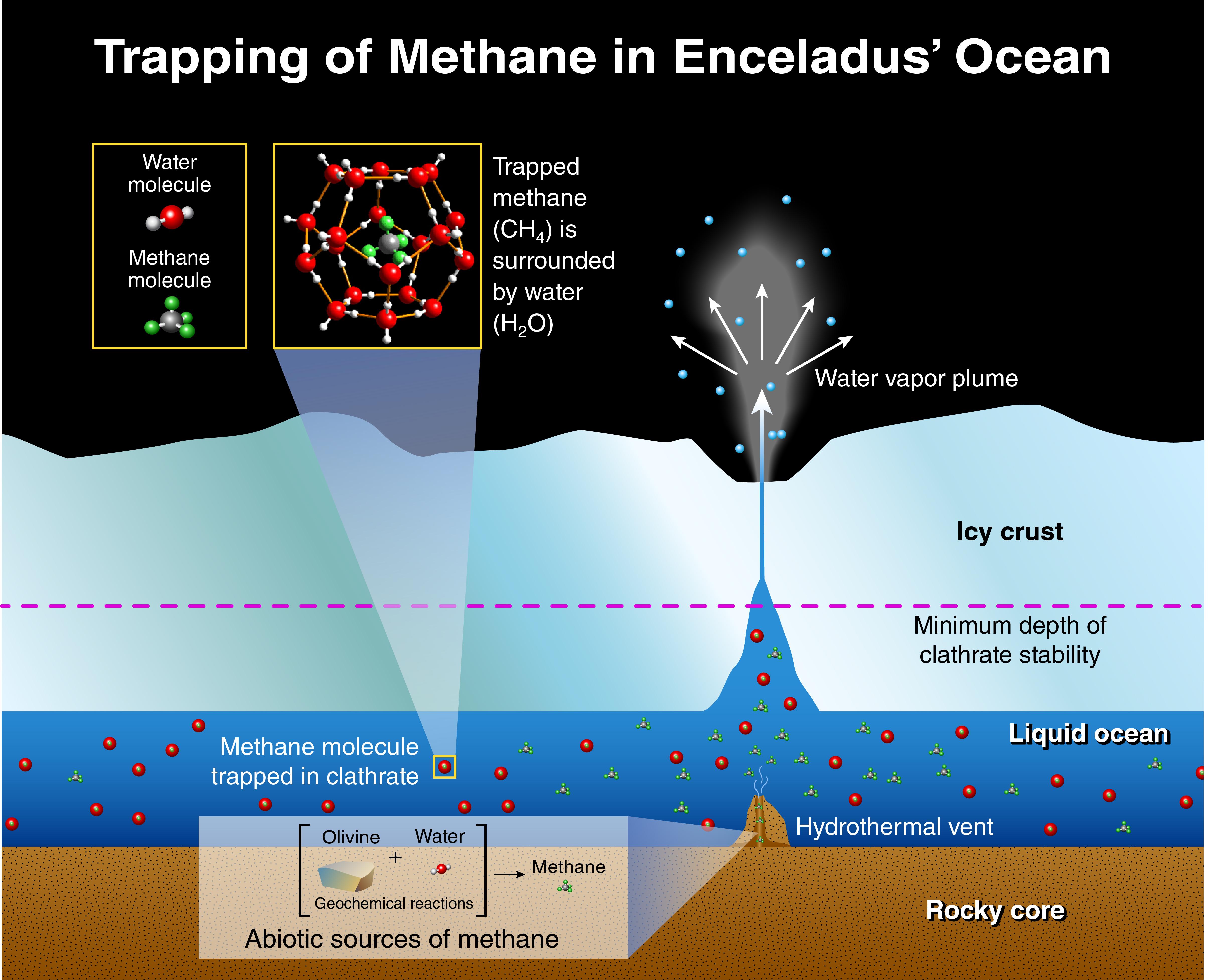
English: PIA19059: Trapping of Methane In Enceladus' Ocean
http://photojournal.jpl.nasa.gov/catalog/PIA19059 This illustration depicts potential origins of methane found in the plume of gas and ice particles that sprays from Saturn's moon, Enceladus, based on research by scientists working with the Ion and Neutral Mass Spectrometer on NASA's Cassini mission. Scientists believe the plumes originate from an internal liquid-water ocean beneath the moon's south polar region. Recent findings from Cassini suggest hydrothermal activity as one of two likely sources of methane in the plume of gas and ice particles that erupts from the south polar region of Enceladus. The finding is the result of extensive modeling to address why methane, as previously sampled by Cassini, is curiously abundant in the plume. Researchers with Cassini's Ion and Neutral Mass Spectrometer (INMS) determined that, at the high pressures expected in the moon's ocean, icy materials called clathrates could form that imprison methane molecules within a crystal structure of water ice. Their models indicated that this process could be so efficient at depleting methane from Enceladus' ocean that they still needed an explanation for the methane abundance in the plume. In one scenario, hydrothermal processes supersaturate the ocean with methane. This could occur if methane is produced faster than it is converted into clathrates. A second possibility is that methane clathrates from the ocean are dragged along into the erupting plumes and release their methane as they rise, like bubbles forming in a popped bottle of champagne. The authors agree that both scenarios are likely occurring to some degree, but they note that the presence of nanosilica grains, as documented by Cassini's Cosmic Dust Analyzer (CDA) instrument, favors the hydrothermal scenario. The Cassini-Huygens mission is a cooperative project of NASA, the European Space Agency and the Italian Space Agency. NASA's Jet Propulsion Laboratory, a division of the California Institute of Technology in Pasadena, manages the mission for NASA's Science Mission Directorate, Washington. The Cassini CDA instrument was provided by the German Aerospace Center; the instrument team, led by Ralf Srama, is based at the University of Stuttgart in Germany. The INMS team is based at Southwest Research Institute, San Antonio, Texas. For more information about the Cassini-Huygens mission visit http://saturn.jpl.nasa.gov and http://www.nasa.gov/cassini. |
|||
| Datum | ||||
| Quelle | http://photojournal.jpl.nasa.gov/jpeg/PIA19059.jpg | |||
| Urheber | NASA/JPL-Caltech/SwRI | |||
| Andere Versionen |
|


Lizenz

|
Der Urheberrechtsinhaber dieser Datei, NASA/JPL-Caltech, erlaubt es jedem, diese für jeden Zweck zu benutzen, vorausgesetzt, dass der Urheberrechtsinhaber ordnungsgemäß genannt wird. Weiterverbreitung, Abänderungen, kommerzielle Nutzung sowie jede andere Verwendung sind gestattet. |
|
|
 
|
According to JPL's image use policy additional restriction is that no endorsement of any product or service by Caltech, JPL or NASA is claimed or implied.
Caltech's disclaimer: Caltech makes no representations or warranties with respect to ownership of copyrights in the images, and does not represent others who may claim to be authors or owners of copyright of any of the images, and makes no warranties as to the quality of the images. Caltech shall not be responsible for any loss or expenses resulting from the use of the images, and you release and hold Caltech harmless from all liability arising from such use. Usage on the English Wikipedia: On the English Wikipedia you can use the {{JPL Image}} template to display the copyright notice. (See w:Wikipedia:Using JPL images for details) |
Dateiversionen
Klicke auf einen Zeitpunkt, um diese Version zu laden.
| Version vom | Vorschaubild | Maße | Benutzer | Kommentar | |
|---|---|---|---|---|---|
| aktuell | 12:55, 12. Mär. 2015 | | 4.820 × 3.906 (7,6 MB) | wikimediacommons>Drbogdan | User created page with UploadWizard |
Dateiverwendung
Die folgende Seite verwendet diese Datei:
