
Datei:NGC 6745.jpg
Größe dieser Vorschau: 623 × 599 Pixel. Weitere Auflösungen: 250 × 240 Pixel | 499 × 480 Pixel | 755 × 726 Pixel.


Originaldatei (755 × 726 Pixel, Dateigröße: 516 KB, MIME-Typ: image/jpeg)
Beschreibung
| Beschreibung |
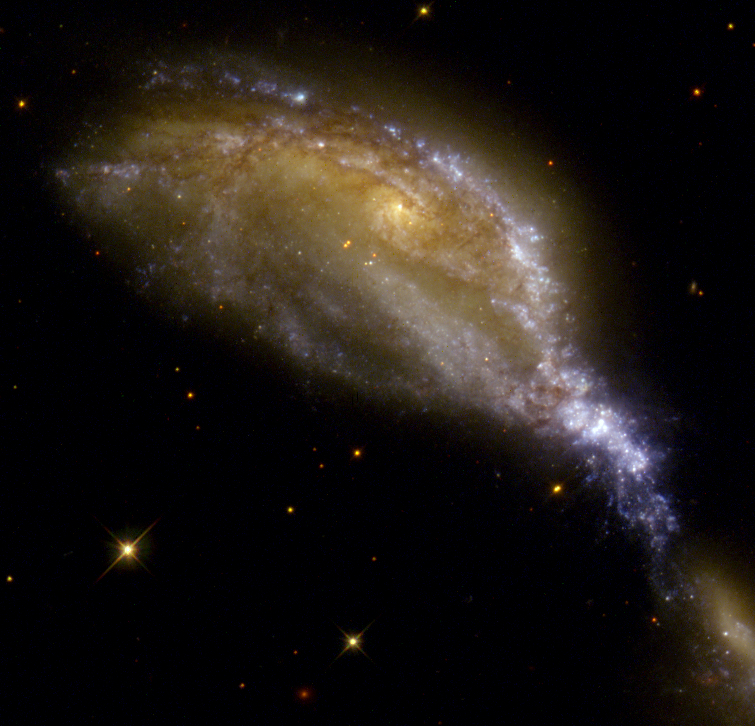
A Bird's eye view of a Galaxy Collision What appears as a bird's head, leaning over to snatch up a tasty meal, is a striking example of a galaxy collision in NGC 6745. A large spiral galaxy, with its nucleus still intact, peers at the smaller passing galaxy (nearly out of the field of view at lower right), while a bright blue beak and bright whitish-blue top feathers show the distinct path taken during the smaller galaxy's journey. These galaxies did not merely interact gravitationally as they passed one another, they actually collided. When galaxies collide, the stars that normally comprise the major portion of the luminous mass of each of the two galaxies will almost never collide with each other, but will pass rather freely between each other with little damage. This occurs because the physical size of individual stars is tiny compared to their typical separations, making the chance of physical encounter relatively small. In our own Milky Way galaxy, the space between our Sun and our nearest stellar neighbor, Proxima Centauri (part of the Alpha Centauri triple system), is a vast 4.3 light-years. However, the situation is quite different for the interstellar media in the above two galaxies - material consisting largely of clouds of atomic and molecular gases and of tiny particles of matter and dust, strongly coupled to the gas. Wherever the interstellar clouds of the two galaxies collide, they do not freely move past each other without interruption but, rather, suffer a damaging collision. High relative velocities cause ram pressures at the surface of contact between the interacting interstellar clouds. This pressure, in turn, produces material densities sufficiently extreme as to trigger star formation through gravitational collapse. The hot blue stars in this image are evidence of this star formation. This image was created by the Hubble Heritage Team using NASA Hubble Space Telescope archive data taken with the Wide Field Planetary Camera 2 in March 1996. Members of the science team, which include Roger Lynds (KPNO/NOAO) and Earl J. O'Neil, Jr. (Steward Obs.), used infrared, red, visual and ultravoilet filters to image this galaxy system. Lynds and O'Neil are currently using the Hubble data along with ground-based radio observations to further study the interactions within NGC 6745. Image Credit: NASA and The Hubble Heritage Team (STScI/AURA) Acknowledgment: Roger Lynds (KPNO/NOAO) |
| Datum | |
| Quelle | The Goddard Library |
| Urheber | NASA Goddard Space Flight Center NASA-GSFC |

|
Diese Mediendatei wurde vom Goddard Space Flight Center der US-amerikanischen National Aeronautics and Space Administration (NASA) unter der Datei-ID GL-2002-001105 kategorisiert. Diese Markierung zeigt nicht den Urheberrechtsstatus des zugehörigen Werks an. Es ist in jedem Falle zusätzlich eine normale Lizenzvorlage erforderlich. Siehe Commons:Lizenzen für weitere Informationen. Sprachen:
|
Lizenz

|
Diese Datei ist gemeinfrei, da sie von NASA und ESA erstellt wurde. Das Hubble-Material der NASA (und das Hubble-Material der ESA vor 2009) ist urheberrechtsfrei und kann ohne Gebühr als gemeinfrei verwendet werden, sofern nur die NASA, das STScI und/oder die ESA als Quelle des Materials angegeben werden. Diese Lizenz gilt nicht, wenn ESA-Material, das nach 2008 erstellt wurde, oder Quellmaterial anderer Organisationen verwendet wird.
Das Material wurde für die NASA vom Space Telescope Science Institute unter dem Vertrag NAS5-26555 oder für die ESA vom Hubble European Space Agency Information Centre erstellt. Urheberrechtserklärung auf hubblesite.org oder 2008 Urheberrechtserklärung auf spacetelescope.org. Für Material, das von der European Space Agency auf der Website spacetelescope.org seit 2009 erstellt wurde, verwende die Lizenzvorlage {{ESA-Hubble}}. |
Ursprüngliches Datei-Logbuch
(All user names refer to en.wikipedia)
- 2006-02-06 00:35 Ryanrs 755×726×8 (528025 bytes) [http://library01.gsfc.nasa.gov/search/images/imageslist.php?id=115&searchterm=everything&searchfield=entire NASA Goddard Library]
- 2005-09-25 23:18 Hurricane Devon 500×481×8 (13644 bytes)
Dateiversionen
Klicke auf einen Zeitpunkt, um diese Version zu laden.
| Version vom | Vorschaubild | Maße | Benutzer | Kommentar | |
|---|---|---|---|---|---|
| aktuell | 05:01, 31. Mai 2007 | | 755 × 726 (516 KB) | wikimediacommons>Spyder Monkey | {{Information |Description=''no original description'' |Source=Originally from [http://en.wikipedia.org en.wikipedia]; description page is/was [http://en.wikipedia.org/w/index.php?title=Image%3ANGC_6745.jpg here]. |Date=2005-09-25 (first version); 2006-02 |
Dateiverwendung
Die folgende Seite verwendet diese Datei:
