Datei:Making a Spectacle of Star Formation in Orion.jpg


Originaldatei (2.048 × 3.250 Pixel, Dateigröße: 2,02 MB, MIME-Typ: image/jpeg)

Beschreibung
| Beschreibung |
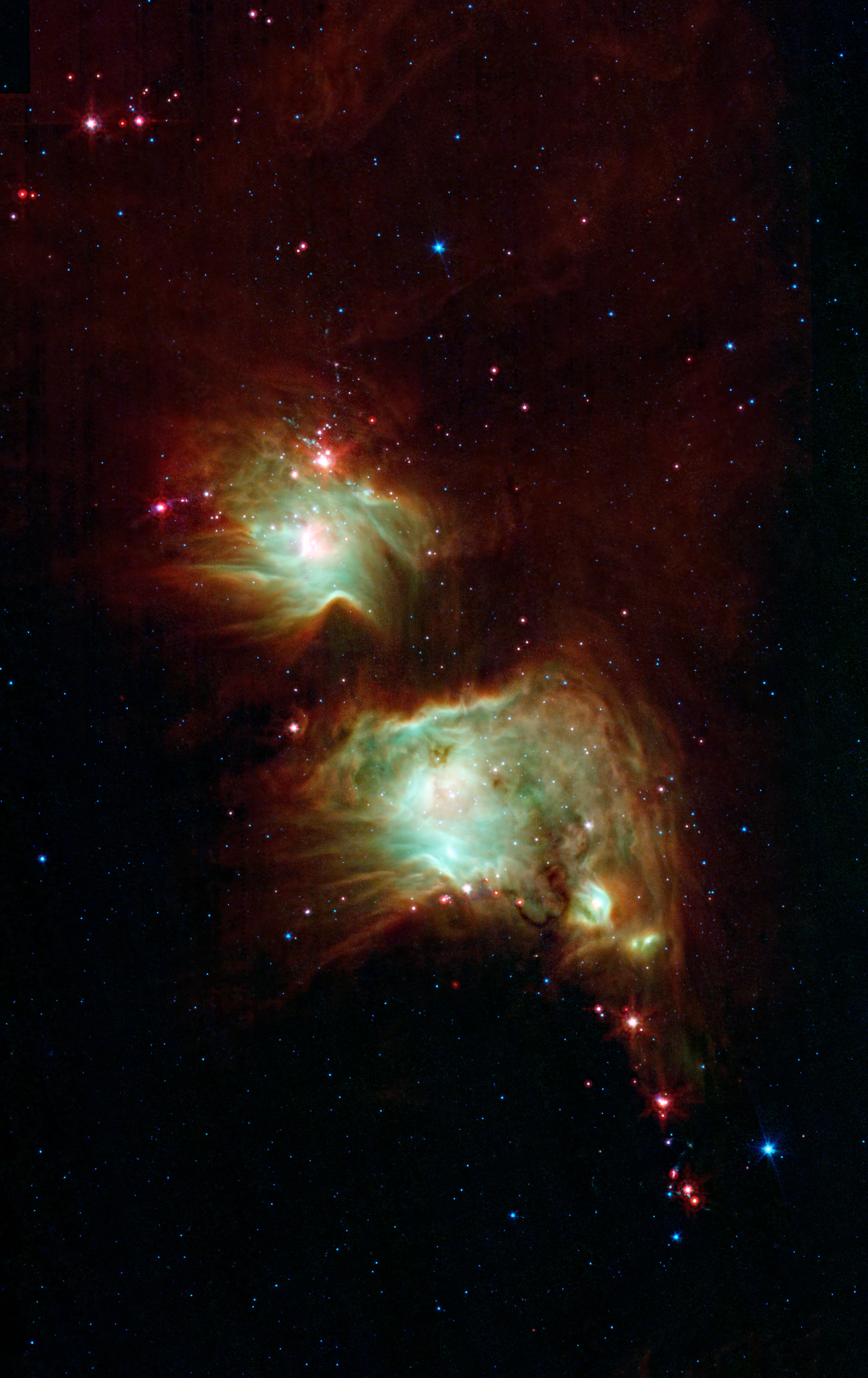
English: Looking like a pair of eyeglasses only a rock star would wear, this nebula brings into focus a murky region of star formation.
Best known as Messier 78, the two round greenish nebulae are actually cavities carved out of the surrounding dark dust clouds. The extended dust is mostly dark, even to Spitzer's view, but the edges show up in mid-wavelength infrared light as glowing red frames surrounding the bright interiors. The light from young, newborn stars are starting to carve out cavities within the dust, and eventually, this will become a larger nebula. A string of baby stars that have yet to burn their way through their natal shells can be seen as red pinpoints on the outside of the nebula. Eventually these will blossom into their own glowing balls, turning this two-eyed eyeglass into a many-eyed monster of a nebula. |
| Datum | |
| Quelle | Spitzer |
| Urheber | NASA/JPL-Caltech |
This is a three-color composite that shows infrared observations from two Spitzer instruments. Blue represents 3.6- and 4.5-micron light and green shows light of 5.8 and 8 microns, both captured by Spitzer's infrared array camera. Red is 24-micron light detected by Spitzer's multiband imaging photometer.
Lizenz

|
Diese Datei ist gemeinfrei (public domain), da sie von der NASA erstellt worden ist. Die NASA-Urheberrechtsrichtlinie besagt, dass „NASA-Material nicht durch Urheberrecht geschützt ist, wenn es nicht anders angegeben ist“. (NASA-Urheberrechtsrichtlinie-Seite oder JPL Image Use Policy). |  |
 |
Warnung:
|
Dateiversionen
Klicke auf einen Zeitpunkt, um diese Version zu laden.
| Version vom | Vorschaubild | Maße | Benutzer | Kommentar | |
|---|---|---|---|---|---|
| aktuell | 17:15, 4. Mai 2012 | | 2.048 × 3.250 (2,02 MB) | wikimediacommons>Rotatebot | Bot: Image rotated by 90° |
Dateiverwendung
Die folgende Seite verwendet diese Datei:
