
Datei:Five Myr Climate Change.png
Five_Myr_Climate_Change.png (745 × 224 Pixel, Dateigröße: 18 KB, MIME-Typ: image/png)
Beschreibung
| Beschreibung |
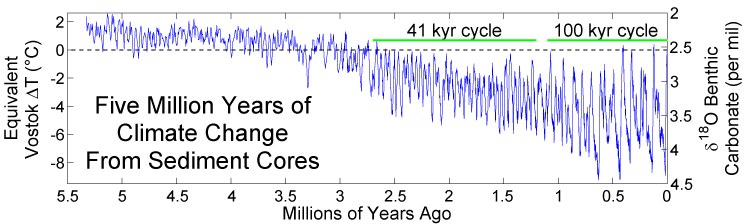
reconstruction of the past 5 million years of climate history, based on oxygen isotope fractionation (serving as a proxy for the total global mass of glacial ice sheets). See the discussion below for a summary of the methods and models used. Note that in 2010, User:SeL media switched the orientation of the time axis and the vertical axes, apparently without discussion, and some descriptions of the image may refer to the older version, resulting in confusion of 'right' and 'left' in the image. |
| Datum | |
| Quelle | original image by User:Dragons flight, based on data (figure 4?) from Lisiecki and Raymo (2005) |
| Urheber | Dragons flight (Robert A. Rohde) |
| Genehmigung (Weiternutzung dieser Datei) |
This figure was prepared by Robert A. Rohde based on published data and is incorporated into the Global Warming Art project. |
| Andere Versionen | vector versions (note the loss in graph resolution, do not use!): Five Myr Climate Change.svg, File:Five Myr Climate Change-ml.svg, Five Myr Climate Change (de) File:Vijf miljoen jaar zuurstofisotopen.svg |


.svg)

Discussion


This figure shows the climate record of Lisiecki and Raymo (2005) [1] constructed by combining measurements from 57 globally distributed deep sea sediment cores. The measured quantity is oxygen isotope fractionation (δ18O) in benthic foraminifera, which serves as a proxy for the total global mass of glacial ice sheets.
Lisiecki and Raymo constructed this record by first applying a computer aided process of adjusting individual "wiggles" in each sediment core to have the same alignment (i.e. wiggle matching). Then the resulting stacked record is orbitally tuned by adjusting the positions of peaks and valleys to fall at times consistent with an orbitally driven ice model (see Milankovitch cycles). Both sets of these adjustments are constrained to be within known uncertainties on sedimentation rates and consistent with independently dated tie points (if any). Constructions of this kind are common. However, they assume that ice volume is driven by changes in insolation, and such data therefore cannot be used to establish the existence of such a relationship.
Many studies have produced evidence that the two strongest orbital cycles (obliquity, 41 kyr and precession, 26 kyr) probably do drive changes in ice volume. The data in the figure have been fitted to these periods and also to the longer, much weaker 100 kyr eccentricity cycle. Over the past ~1 million years there have been a number of very strong glacial maxima and minima, spaced by 80,000 - 120,000 years, but the evidence for orbital forcing of these events is less secure. It is likely that this ~100 kyr cycle is controlled by some other as yet unknown mechanism. For further discussion of orbital periodicities see Milankovitch cycles.
The observed isotope variations are very similar in shape to the temperature variations recorded at Vostok, Antarctica during the 420 kyr for which that record exists. Hence the right hand scale of the figure was established by fitting the reported temperature variations at Vostok (Petit et al. 1999) to the observed isotope variations. This temperature scale should be regarded as approximate and its magnitude only representative of the changes observed in the Vostok core. In particular, temperature changes at polar sites such as Vostok frequently exceed the changes observed in the tropics or in the global average. A horizontal line at 0 °C indicates modern temperatures (circa 1950).
References
- Lisiecki, Lorraine E.; Raymo, Maureen E. (January 2005). "A Pliocene-Pleistocene stack of 57 globally distributed benthic d18O records" (PDF). Paleoceanography 20: PA1003. DOI:10.1029/2004PA001071.
- Supplement: Lisiecki, L. E.; Raymo, M. E. (2005). "Pliocene-Pleistocene stack of globally distributed benthic stable oxygen isotope records". Pangaea. DOI:10.1594/PANGAEA.704257.
- Lisiecki, L. E.; Raymo, M. E. (May 2005). "Correction to “A Pliocene-Pleistocene stack of 57 globally distributed benthic d18O records”". Paleoceanography: PA2007. DOI:10.1029/2005PA001164.
- Petit, J. R.; Jouzel, J.; Raynaud, D.; Barkov, N. I.; Barnola, J. M.; Basile, I.; Bender, M.; Chappellaz, J.; Davis, J.; Delaygue, G.; Delmotte, M.; Kotlyakov, V. M.; Legrand, M.; Lipenkov, V.; Lorius, C.; Pépin, L.; Ritz, C.; Saltzman, E.; Stievenard, M. (1999). "Climate and Atmospheric History of the Past 420,000 years from the Vostok Ice Core, Antarctica". Nature 399: 429-436. DOI:10.1038/20859.

|
Es ist erlaubt, die Datei unter den Bedingungen der GNU-Lizenz für freie Dokumentation, Version 1.2 oder einer späteren Version, veröffentlicht von der Free Software Foundation, zu kopieren, zu verbreiten und/oder zu modifizieren; es gibt keine unveränderlichen Abschnitte, keinen vorderen und keinen hinteren Umschlagtext.
Der vollständige Text der Lizenz ist im Kapitel GNU-Lizenz für freie Dokumentation verfügbar. |
  
|
Diese Datei ist unter der Creative-Commons-Lizenz „Namensnennung – Weitergabe unter gleichen Bedingungen 3.0 nicht portiert“ lizenziert. | |
| ||
| Diese Lizenzmarkierung wurde auf Grund der GFDL-Lizenzaktualisierung hinzugefügt. |
| Dragons flight's Temperature Record Series |
| This figure is part of a series of plots created by Dragons flight to illustrate changes in Earth's temperature and climate across many different time scales. |
| Time Period: 25 yrs | 150 yrs | 1 kyr | 2 kyr | 12 kyr | 450 kyr | 5 Myr | 65 Myr | 500 Myr |
| For articles related to this topic see: Temperature record |


Dateiversionen
Klicke auf einen Zeitpunkt, um diese Version zu laden.
| Version vom | Vorschaubild | Maße | Benutzer | Kommentar | |
|---|---|---|---|---|---|
| aktuell | 13:25, 18. Jul. 2010 | | 745 × 224 (18 KB) | wikimediacommons>SeL media | time axis reversed |
Dateiverwendung
Keine Seiten verwenden diese Datei.
