
Datei:Caldwell 42.jpg



Originaldatei (3.851 × 3.851 Pixel, Dateigröße: 11,11 MB, MIME-Typ: image/jpeg)
Beschreibung
| Beschreibung |
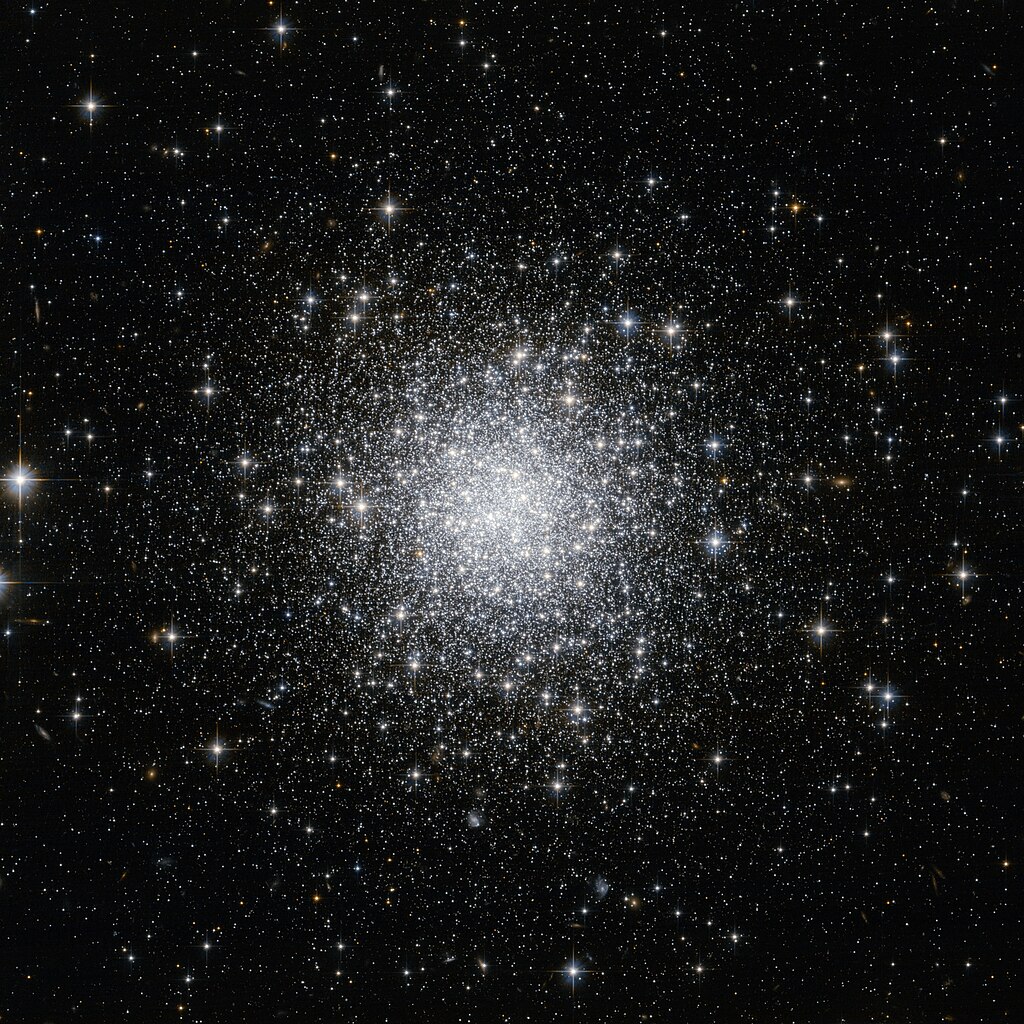
English: Caldwell 42, also known as NGC 7006, is one of 18 globular clusters in the Caldwell catalog. If you look at this Hubble image of the cluster closely, you may be able to spot several tiny background galaxies (which appear fuzzier and more extended than the cluster’s stars). Each of those distant island universes likely contains a hundred or more globular clusters of its own. Unlike open star clusters, which are smaller and more loosely bound, globular clusters are densely packed with hundreds of thousands of stars held in a roughly spherical shape by their mutual gravity.
Globular clusters like Caldwell 42 are relics of the galaxy’s earliest years. Since they were born as the nascent galaxy was forming, these clusters provide a glimpse backward in time and provide a hint of what the Milky Way was like billions of years ago. Studying globular clusters allows scientists to learn more about how the first stars formed in our galaxy and the role the clusters played in the galaxy’s development. However, Caldwell 42 has a very elongated orbit around the center of our galaxy, which might hint toward an extragalactic origin. It seems that some globular clusters may have once been independent dwarf galaxies that were later absorbed by the Milky Way. The cluster is nestled in the diminutive constellation Delphinus and is best viewed in the late summer in the Northern Hemisphere or late winter in the Southern Hemisphere. It was discovered in 1784 by British astronomer William Herschel — the discoverer of dozens of celestial objects in the Caldwell catalog. Caldwell 42 isn’t terribly bright to begin with compared to other star clusters, so at its distance of about 135,000 light-years from Earth it’s really not the most impressive sight to most amateur astronomers. In a moderate-sized telescope, the magnitude-10.5 cluster appears as a dim, circular smudge. It is difficult to pick out individual stars in the cluster, though large amateur telescopes may be able to resolve a few of the cluster’s most vibrant stellar members. This image, taken by Hubble’s Advanced Camera for Surveys, includes light detected at both visible and infrared wavelengths. When viewed in visible wavelengths alone, Caldwell 42 appears dimmer. This is because intervening dust between us and Caldwell 42 scatters some of the cluster’s visible light but lets the infrared light pass through. Hubble’s multi-wavelength view transforms this otherwise faint smudge into a dazzling spectacle, while helping astronomers analyze the cluster’s stars and investigate Caldwell 42’s history. For more information about Hubble’s observations of Caldwell 42, see: www.spacetelescope.org/images/potw1137a/ Credit: ESA/Hubble & NASA For Hubble's Caldwell catalog site and information on how to find these objects in the night sky, visit: www.nasa.gov/content/goddard/hubble-s-caldwell-catalog |
| Datum | |
| Quelle | https://www.flickr.com/photos/144614754@N02/49200475127/ |
| Urheber | NASA Hubble |
Lizenz


- Dieses Werk darf von dir
- verbreitet werden – vervielfältigt, verbreitet und öffentlich zugänglich gemacht werden
- neu zusammengestellt werden – abgewandelt und bearbeitet werden
- Zu den folgenden Bedingungen:
- Namensnennung – Du musst angemessene Urheber- und Rechteangaben machen, einen Link zur Lizenz beifügen und angeben, ob Änderungen vorgenommen wurden. Diese Angaben dürfen in jeder angemessenen Art und Weise gemacht werden, allerdings nicht so, dass der Eindruck entsteht, der Lizenzgeber unterstütze gerade dich oder deine Nutzung besonders.

|
Diese Bilddatei wurde ursprünglich auf Flickr durch NASA Hubble in https://flickr.com/photos/144614754@N02/49200475127 (Archiv) hochgeladen. Sie wurde am 23. Februar 2020 durch den FlickreviewR 2-Bot geprüft und die Lizenzierung der Datei unter den Bedingungen von cc-by-2.0 wurde bestätigt. |
Dateiversionen
Klicke auf einen Zeitpunkt, um diese Version zu laden.
| Version vom | Vorschaubild | Maße | Benutzer | Kommentar | |
|---|---|---|---|---|---|
| aktuell | 20:04, 23. Feb. 2020 | | 3.851 × 3.851 (11,11 MB) | wikimediacommons>Killarnee | User created page with UploadWizard |
Dateiverwendung
Die folgende Seite verwendet diese Datei:
